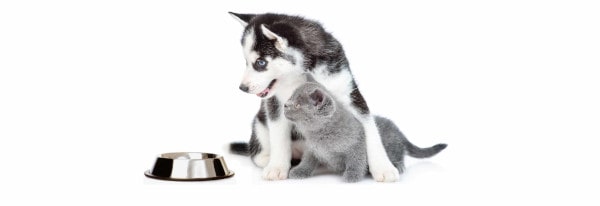
An adult, calm dog needs around 50-60 ml of water per kilogram of body weight a day and a cat around 50 ml, but these are only rough values. The water needs changing at least once a day, and the bowl should be washed like an ordinary mug, because microbes grow in leftover water and on the sides. A persistent change in the amount of water drunk is a sign to consult your vet.
Water is one of the most important things needed for life, and our animals, just like us, do not like being left without access to clean, fresh water. How much of it we need under stable conditions is described by the daily water requirement expressed in millilitres per kilogram of body weight. For an adult human weighing 60 kg, that is around 2-2.5 litres of water a day [1].
Below we explain how much water dogs and cats need, where they get it from, how to give it and how to look after the bowl so that the water is genuinely safe.
How much water dogs and cats need

For an adult, calm dog, the daily requirement is 50-60 ml of water per kilogram of body weight, and for a cat it is similar, around 50 ml per kilogram [2]. These are, however, average values for adult animals at an optimal temperature and with minimal exertion [3-5].
Such a general parameter is not precise, but it helps:
- to understand that animals simply need water,
- to estimate a range for how much water they need,
- to explain that water is not only what is in the bowl, but also what the animal eats.
It is easier to tell an owner that their cat needs roughly a glass of water a day than to explain straight away where that water comes from and that cats have special adaptations for recovering it [6].
Where dogs and cats get water from and what thirst depends on
How much water an animal takes in results from physiological factors that regulate thirst. These are influenced by cellular homeostasis and the daily cycle, which constantly swings between mild dehydration and overhydration [2,7].
The requirement can be calculated in ml per kg of body weight, in ml per kg of dry matter eaten or in ml per kcal eaten. In each of these methods, water is the sum of three sources [2,8]:
- the moisture contained in food,
- free water, i.e. water from the bowl,
- metabolic water, which is produced in the body’s biochemical reactions.
‘A glass of water for a cat’ is therefore a more complex notion, and water is just one element of a balanced diet [8,9].
Changes in drinking - what to watch for
The water bowl lets you keep an eye on what is happening with your pet day to day. Increased drinking (polydipsia) or reduced drinking (adipsia) can be a temporary and perfectly natural state [3,10,11]. A dog drinks the whole bowl in a few minutes after a walk lasting several hours, and after a switch to a drier food it makes up the shortfall with water from the bowl [2].
On the other hand, a frightened cat usually avoids drinking, and after a switch to a food with a higher water content an animal drinks less from the bowl. A common cause of changes is also boredom or behavioural problems: the animal plays with the water, which looks like a sudden increase in drinking, or stops drinking because it copes badly with separation from its owner [12,13].
When a change in drinking needs a vet’s opinion
A change that persists and has no simple explanation may suggest that something is going on. Then it is worth seeking advice. Changes in the amount of water drunk can accompany, among other things:
- urinary tract inflammation, often accompanied by more frequent urination in unusual places [13,14],
- diabetes (dogs and cats) [15,16],
- Cushing’s disease (dogs) [15,16],
- hyperthyroidism (cats) [15,16],
- kidney disease [17,18],
- the use of certain medicines, especially anticonvulsants and steroids [17,18].
How to give your dog water: bowl, location and constant access

There are almost as many opinions on how to give water as there are owners. With dogs it is fairly simple: an ordinary bowl is the best choice [5,8]. What matters is choosing a bowl size to suit the dog (a puppy falling into a bowl four times its size is no fun) and where it stands.
In most homes the water bowl stands next to the food bowl. Is that the best solution? Yes and no. It is best to watch the animal’s behaviour and, in more difficult cases, consult a behaviourist or vet [13].
Should a dog have water all the time?
Constant access to water (ad libitum) is not always a good idea [2,19]. A very active dog that drinks a whole bowl at once after an hour of running will most likely bring it straight back up. It is better to ration its water in portions for about half an hour [20]. The same goes for a dog that loves playing with water: constant access will only make it worse. If your dog behaves oddly at the bowl, it is worth looking for the cause with the help of a specialist [20].
At what height should the bowl stand?
In general it is better if the bowl stands a little higher than the floor [2,9,20], high enough that the animal does not have to stretch its neck. This matters especially for large dog breeds [6]. If we see that the position when eating or drinking is uncomfortable or painful, it needs changing. With some conditions, e.g. oesophageal achalasia, a dog should eat with its front paws much higher than its back paws to limit regurgitation.
Bowl or fountain for a cat
Here there is no clear-cut answer [2,6,21]. There are plenty of opinions online, but there is a lack of studies on a large, representative group of animals. Cats have particular preferences and one bowl is often not enough, so it is worth paying attention to the number and placement of water sources.
In a study of the preferences of 549 cats [6]:
- more than 80% of cats drank mainly from a bowl, fewer than 20% from a fountain,
- cats with access to both sources chose the bowl 60% of the time,
- cats clearly preferred bowls less than 15 cm in diameter, and the bowl material did not matter to them,
- at least 2 bowls per cat were recommended [6,20].
Which water and how often to change it

Whatever the type of bowl and the species of animal, the key is the cleanliness and quality of the water and how often we change it [6]. If the owner can drink the water, so can the pet. It is usually the owner’s preference that decides whether the animal drinks bottled or tap water [5,6,10]. The most important thing is that the water is available and fresh, i.e. changed at least once a day.
Sometimes a pet, despite a lovely bowl full of fresh water, prefers a puddle or the aquarium [6,11,20]. That is a valuable observation, because it shows we have not fully understood what the animal needs.
Why the bowl must be washed
Changing the water every day is obvious, but looking after the bowl itself is not [22]. Changing the water does little good if the bowl was washed a week ago. Bacteria grow in the water itself: whatever the animal has in its mouth, on its muzzle and sometimes on its paws stays in the bowl. Many microbes form a biofilm that clings firmly to the surface and is hard to remove. Simply rinsing the bowl or fountain under running water is not enough [23].
Just as we do not like drinking from a dirty mug, some animals:
- will not drink from a dirty container, even if fresh water has been poured into it,
- may be exposed to infection because of it.
This is especially clear when several animals share bowls. One sick animal can leave an infectious agent in the water, and others can catch it [22,24,25]. That is why we should treat the water bowl like an ordinary mug and wash it as often as possible.
The risks of topping up water and an unwashed bowl

Topping up the water in the bowl is not always a good solution [26]. The leftover water at the bottom, together with bits of food, is a good medium for microbial growth. Whatever the animal has on its tongue, gums, teeth and skin folds usually keeps multiplying in an unwashed bowl, especially on a warm day, or forms a reservoir [27-29].
With a wound or cut around the mouth, such water can be a source of infection, e.g. with bacteria of the genus Staphylococcus, Streptococcus and, in more serious cases, Pseudomonas. With several animals, the flora of one can be dangerous to another and cause pus-filled lesions around the mouth, diarrhoea or transmit parasites [26,28-31].
What affects how much an animal drinks
- factors related to the animal: age, sex, state of health,
- its preferences: the type of container, their placement, drinking alone or with others around,
- the environment: temperature, air humidity, type of food,
- the water itself: its cleanliness and quality.
Balancing these elements depends to a large extent on the owner’s careful observation and, in difficult cases, on working with a behaviourist and a vet.
Author: Dominik Łagowski, DVM, Sub-Department of Veterinary Microbiology, Faculty of Veterinary Medicine
Bibliography
- Maughan RJ. Introduction to the European Hydration Institute’s Expert Conference on Human Hydration, Health, and Performance. Nutr. Rev. United States; 2015. p. 55-6.
- Nutrient Requirements of Dogs and Cats [Internet]. Washington, D.C.: National Academies Press; 2006. Available from: http://www.nap.edu/catalog/10668
- Finco DR, Adams DD, Crowell WA, Stattelman AJ, Brown SA, Barsanti JA. Food and water intake and urine composition in cats: influence of continuous versus periodic feeding. Am J Vet Res. United States; 1986;47:1638-42.
- Perrier ET, Johnson EC, McKenzie AL, Ellis LA, Armstrong LE. Urine colour change as an indicator of change in daily water intake: a quantitative analysis. Eur J Nutr [Internet]. 2016;55:1943-9. Available from: https://doi.org/10.1007/s00394-015-1010-2
- Zentek J. Nutritional Guidelines For Complete and Complementary Pet Food for Cats and Dogs. FEDIAF; 2019.
- Fritz J, Handl S. THE WATER REQUIREMENTS AND DRINKING HABITS OF CATS. Vet Focus. 2018;28.
- Armstrong LE. Hydration Biomarkers During Daily Life: Recent Advances and Future Potential. Nutr Today [Internet]. 2012;47. Available from: https://journals.lww.com/nutritiontodayonline/Fulltext/2012/07001/Hydration_Biomarkers_During_Daily_Life__Recent.2.aspx
- Zanghi BM, Gerheart L, Gardner CL. Effects of a nutrient-enriched water on water intake and indices of hydration in healthy domestic cats fed a dry kibble diet. Am J Vet Res. United States; 2018;79:733-44.
- Zanghi BM, Gardner CL. Total Water Intake and Urine Measures of Hydration in Adult Dogs Drinking Tap Water or a Nutrient-Enriched Water. Front Vet Sci [Internet]. 2018;5:317. Available from: https://www.frontiersin.org/article/10.3389/fvets.2018.00317
- Ramsay DJ, Thrasher TN. Regulation of fluid intake in dogs following water deprivation. Brain Res Bull. United States; 1991;27:495-9.
- ANDERSON RS. Water balance in the dog and cat. J Small Anim Pract [Internet]. 1982;23:588-98. Available from: https://doi.org/10.1111/j.1748-5827.1982.tb02519.x
- Fatjó J, Ruiz-de-la-Torre JL, Manteca X. The epidemiology of behavioural problems in dogs and cats: A survey of veterinary practitioners. Anim Welf. 2006;15.
- Camps T, Amat M, Manteca X. A Review of Medical Conditions and Behavioral Problems in Dogs and Cats. Anim an open access J from MDPI. 2019;9.
- Dru Forrester S, Roudebush P. Evidence-based management of feline lower urinary tract disease. Vet Clin North Am Small Anim Pract. United States; 2007;37:533-58.
- Boland LA, Barrs VR. Peculiarities of feline hyperadrenocorticism: Update on diagnosis and treatment. J Feline Med Surg. England; 2017;19:933-47.
- Kooistra HS, Galac S. Recent advances in the diagnosis of Cushing’s syndrome in dogs. Vet Clin North Am Small Anim Pract. United States; 2010;40:259-67.
- Marks SL, Kook PH, Papich MG, Tolbert MK, Willard MD. ACVIM consensus statement: Support for rational administration of gastrointestinal protectants to dogs and cats. J Vet Intern Med [Internet]. John Wiley & Sons, Ltd; 2018;32:1823-40. Available from: https://doi.org/10.1111/jvim.15337
- Court MH. Feline Drug Metabolism and Disposition: Pharmacokinetic Evidence for Species Differences and Molecular Mechanisms. Vet Clin North Am Small Anim Pract [Internet]. 2013;43:1039-54. Available from: http://www.sciencedirect.com/science/article/pii/S0195561613001162
- Garcia SN, Osburn BI, Cullor JS. A one health perspective on dairy production and dairy food safety. One Heal (Amsterdam, Netherlands). 2019;7:100086.
- Landsberg GM, Hunthausen WL, Ackerman LJ, Landsberg GM. Behavior problems of the dog and cat. 2013.
- Grant DC. Effect of water source on intake and urine concentration in healthy cats. J Feline Med Surg. England; 2010;12:431-4.
- Cabral JPS. Water Microbiology. Bacterial Pathogens and Water. Int. J. Environ. Res. Public Heal. 2010.
- Nogueira Brilhante RS, Correia EEM, De Melo Guedes GM, Pereira VS, De Oliveira JS, Bandeira SP, et al. Quantitative and structural analyses of the in vitro and ex vivo biofilm-forming ability of dermatophytes. J Med Microbiol. England; 2017;66:1045-52.
- Moriello K. Mechanical washing of pet food bowls is effective for Microsporum canis decontamination. Vet Dermatol. 2019;30.
- Ghasemzadeh I, Namazi SS. Review of bacterial and viral zoonotic infections transmitted by dogs. J Med Life. 2015;8:1-5
- O’Brien E, Xagoraraki I. A water-focused one-health approach for early detection and prevention of viral outbreaks. One Heal [Internet]. 2019;7:100094. Available from: http://www.sciencedirect.com/science/article/pii/S2352771418300569
- Lin M-H, Ke W-J, Liu C-C, Yang M-W. Modulation of Staphylococcus aureus spreading by water. Sci Rep [Internet]. 2016;6:25233. Available from: https://doi.org/10.1038/srep25233
- S. Alidadi OA. Water as a Potential Transmission Route of Infection with Tapeworms. J Air Water borne Dis [Internet]. 2015;04. Available from: http://www.omicsgroup.org/journals/water-as-a-potential-transmission-route-of-infection-with-tapeworms-2167-7719-1000e135.php?aid=70363
- COLEMAN BL, SALVADORI MI, McGEER AJ, SIBLEY KA, NEUMANN NF, BONDY SJ, et al. The role of drinking water in the transmission of antimicrobial-resistant E. coli. Epidemiol Infect [Internet]. 2012;140:633-42. Available from: https://www.cambridge.org/core/product/identifier/S0950268811001038/type/journal_article
- Olsen SJ, Miller G, Breuer T, Kennedy M, Higgins C, Walford J, et al. A waterborne outbreak of Escherichia coli O157:H7 infections and hemolytic uremic syndrome: implications for rural water systems. Emerg Infect Dis. 2002;8:370-5.
- Muscarella LF. Contribution of Tap Water and Environmental Surfaces to Nosocomial Transmission of Antibiotic-Resistant Pseudomonas aeruginosa. Infect Control Hosp Epidemiol [Internet]. 2004;25:342-5. Available from: https://www.cambridge.org/core/product/identifier/S0195941700083855/type/journal_article
Products mentioned
 You collect HAU DOLCE points for your purchases
Frequently asked questions
How much water does a dog need a day?
An adult, calm dog needs on average 50-60 ml of water per kilogram of body weight a day. This is a rough value for an optimal temperature and little exertion, and the animal gets some of its water from its food.
How often should I change the water in my dog’s or cat’s bowl?
At least once a day. Washing the bowl itself is just as important, because changing the water in a container washed a week ago does little good, and simply rinsing it does not remove the biofilm.
Can I just top up the water in the bowl?
It is better to avoid it. The leftover water at the bottom of the bowl, with bits of food and the animal’s saliva, is a good medium for microbes to multiply, especially on a warm day.
Bowl or fountain for a cat?
There is no clear-cut answer. In a study of 549 cats, most drank from a bowl, and cats with a choice picked the bowl 60% of the time. Cats preferred bowls less than 15 cm in diameter, and it is worth providing at least 2 bowls per cat.
When should a change in drinking be a concern?
When it lasts longer and has no simple explanation, such as a long walk or a change of food. It may then point to, among other things, urinary tract inflammation, diabetes or kidney disease, so it is worth consulting your vet.